Dead Sea Treasures
What Makes Dead Sea Minerals Different?

Walk down almost any skincare aisle and you will find something with “Dead Sea” printed on the label. Very few explain what the phrase is meant to signify, or why a lake in Jordan should have anything to do with a jar of mud. This is our attempt at a straight answer: what the Dead Sea actually is, why its water is unlike ordinary seawater, how salt and mud are taken from the shore, and how you can tell whether a product genuinely came from there. We have made our products in Jordan, at the Dead Sea, since 1995, so we have an obvious interest in the answer — and we have tried to write the version we would want to read as a sceptic.
The lowest point on land, and why that changes the water
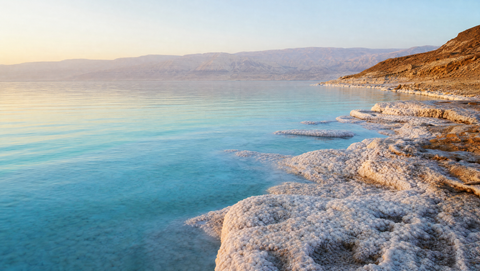
The Dead Sea sits at roughly 430 metres below sea level, the lowest point on land anywhere on the planet. That single piece of geography drives nearly everything else about it.
Water flows into the basin from the surrounding catchment, and there is no outlet. Nothing drains away. The only route out is evaporation, and in a hot, deep basin under strong sun, evaporation is relentless. The water leaves; the dissolved minerals stay. Repeat that for long enough and you get a body of water far more concentrated than ordinary seawater — dense enough that swimming is not really the right word for what people do in it. Floating is.
“Mineral-rich” is vague. Here is the specific part.
Plenty of products call themselves mineral-rich. What makes the Dead Sea genuinely unusual is not only how much dissolved matter its water carries, but what kind.
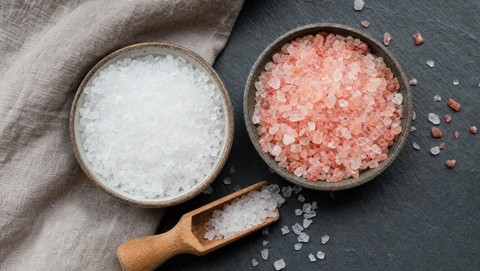
Ordinary seawater is dominated by sodium chloride — table salt. The Dead Sea's profile is arranged differently. It is notably rich in magnesium, potassium and calcium salts, and comparatively lower in ordinary sodium chloride than normal sea water. That is the substantive difference, and it is why “Dead Sea salt” and “sea salt” are not two names for the same material. They dissolve differently, they feel different in bath water, and they usually even look different in the hand: Dead Sea bath salt tends to be coarse and irregular rather than a fine, uniform white powder.
You will notice we have not given you a figure. Precise-sounding numbers circulate constantly in this industry, vary by season and sampling point, and get repeated without a source. Qualitative and honest beats precise and unverifiable.
How the salt and the mud come ashore
Both raw materials are, in the plainest sense, left behind by the sea itself. Neither is manufactured.
Salt
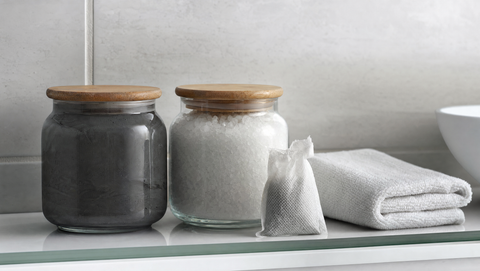
Evaporation is the entire process. As water at the shallow margins evaporates, dissolved salts come out of solution and crystallise, building up as crusts and beds along the shoreline and the shallow flats. Harvesting means collecting that material, then cleaning and grading it — sieving out grit and shore debris, sorting by crystal size. The sun does the work; people collect the result. A coarse grade goes into a bath product like our Dead Sea Mineral Bath Salt, which dissolves slowly in hot water rather than vanishing the moment it hits the tub.
Mud
The dark mud is sediment: very fine particles that settle along the shore and in the shallows, saturated with the same concentrated water. It is collected from the shoreline, screened to take out stones, shells and coarse sand, and worked to a smooth, spreadable consistency. Screening is most of the craft — raw shore sediment is gritty, and grit is the difference between a mask you enjoy and one you do not. It reaches you in two forms: a firmer, clay-textured Facial Mud Mask, and a looser Soft Mud for larger areas.
Water
The water is the simplest of the three. Dead Sea Genuine Water is the sea's own water, filtered of sediment and bottled; there is very little to add. Where the minerals are carried into a lighter everyday format instead, they are formulated into something like our Mineral Beauty Serum.
Why “made at the source” is more than a slogan
Two very different things can carry the words Dead Sea on the front of a box. The first is a product formulated and filled at the Dead Sea, from material taken there. The second is made somewhere else entirely, from material bought through a supply chain — or, at the far end, uses the name as a descriptor, the way a soap might be called “ocean breeze” without having been near an ocean.
The second kind is not worthless; plenty of competent products are made that way. But two practical differences are worth naming:
- The chain is shorter. Fewer handling and shipping steps sit between the shoreline and the jar, and fewer intermediaries means fewer points at which what is in the container can drift from what is on the label.
- One party answers for both ends. When the same company collects the raw material and stands behind the finished product, there is nobody further up the chain to point at.
How to tell what you are actually buying
You do not need to take anyone's word for this, ours included. A few checks are genuinely informative:
- Look for a country of origin, not just a place name. “Dead Sea” on the front is marketing copy. “Made in Jordan” is a statement of origin the seller is answerable for. If a product invokes the Dead Sea prominently but never says where it was made, that gap is the answer.
- Read the ingredient list — and know its limits. Ingredients are listed in descending order of concentration, so a mineral named near the top is present in a meaningful amount and one near the bottom is not. But the standard ingredient names for sea salt and sea silt are generic — they cover material from any sea. An ingredient list can confirm a product contains sea minerals; it cannot, by itself, prove they came from this one. That is exactly why the origin statement matters.
- Check that the net contents are stated. A brand confident in its product tells you how much you are getting, in millilitres or grams, before you buy. A missing size is a small tell about something larger.
- Read the terms, not only the claims. Check shipping charges, return conditions and contact details before buying.
The honest part: what mineral cosmetics can and cannot do
Dead Sea minerals attract a certain amount of mysticism, and we would rather not trade in it. So, plainly:
These are cosmetics. Their job is how skin looks and feels. A mineral bath salt changes the character of the water and leaves skin feeling smooth once you are out and dry. A mud mask goes on cool, dries, and rinses away to an even, clean finish. A serum sinks in quickly and gives the next step something to sit on. That is the honest scope of the category — and it is a real one. The daily business of washing, soaking and moisturising is worth doing well.
What these products are not is medicine. No cosmetic is a substitute for medical care. If you have a specific concern about your skin, the right person to ask is a qualified clinician — not a skincare brand, and not an article on its website.
Two caveats we would want in writing if we were the customer. Individual experience varies: a texture one person finds ideal, another does not, so patch test anything new. And “natural” and “ancient” are not arguments — age is not evidence, and occurring in nature says nothing about whether something suits you. The defensible claim is narrower and, we think, more interesting: an unusual material, formed by an unusual place, prepared close to where it came from.
Where to start
If the geology is what drew you in, the simplest way to meet it is the least processed form — salt in a hot bath, or mud on the skin for a few minutes. If you would rather see what people actually reach for, our bestselling Dead Sea products are a reasonable place to begin, and the full range sits in all products. Everything is made in Jordan, at the Dead Sea, as it has been since 1995.